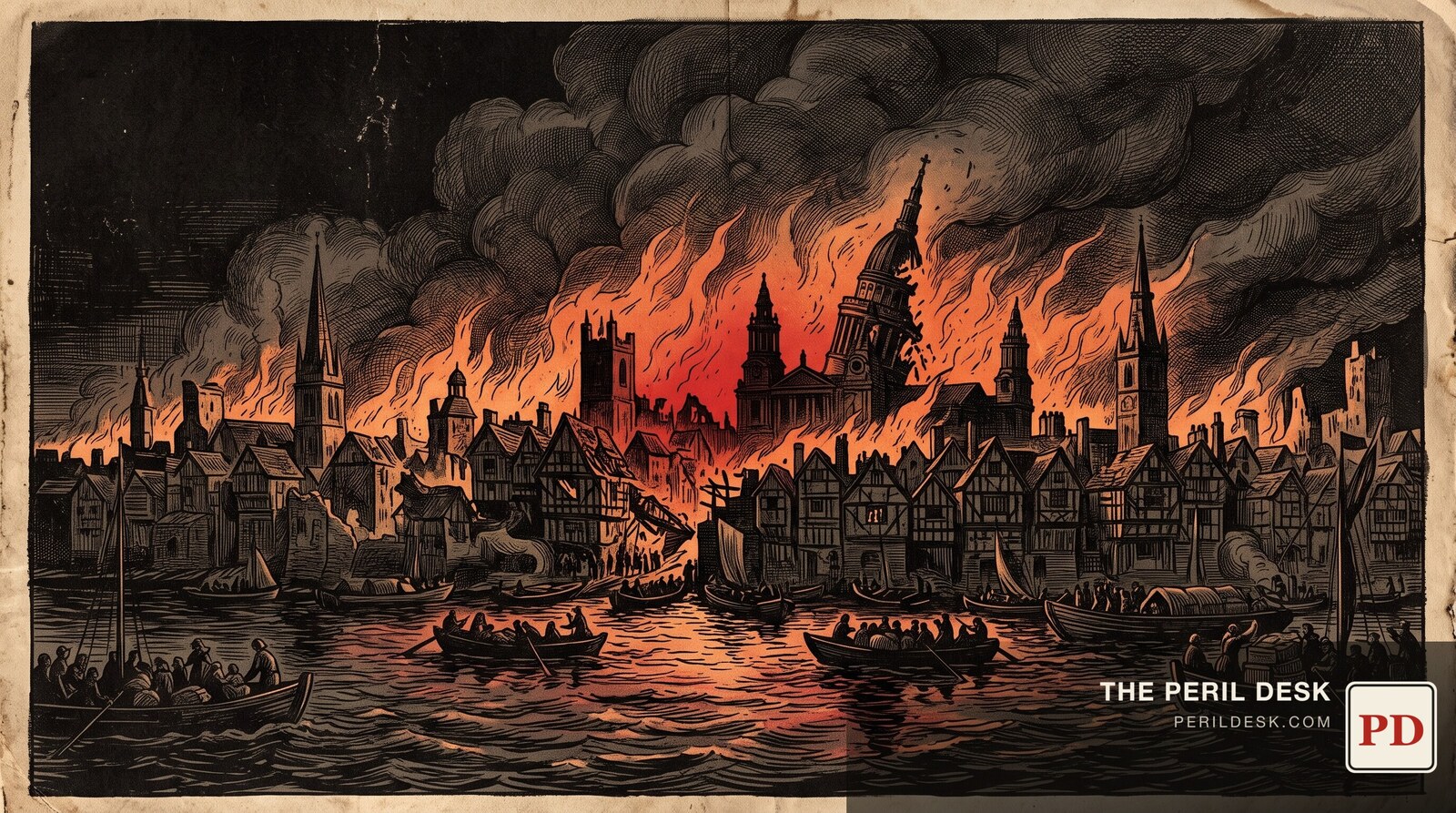
Just after midnight on Sunday, 2 September 1666, fire broke out in Thomas Farriner's bakery on Pudding Lane. Farriner was the King's baker, supplier of ship's biscuit to the Royal Navy, and he denied to the end of his life that his oven started it. He and his daughter climbed out an upstairs window and crossed the rooftops. Their maidservant was too frightened to follow. She died in the bakery, the fire's first recorded victim.
A few streets away, the diarist Samuel Pepys got the news from his servant. "Jane called us up about three in the morning, to tell us of a great fire they saw in the City," he wrote.1 He looked out, judged it far enough off, and went back to bed.
Exhibit. Diary of Samuel Pepys, 2 September 1666. Gutenberg e-text 4167
Some of our mayds sitting up late last night to get things ready against our feast to-day, Jane called us up about three in the morning, to tell us of a great fire they saw in the City.
So did the man who could have stopped it. Lord Mayor Sir Thomas Bloodworth turned down early requests to pull down houses in the fire's path, saying he could not find the owners whose consent demolition required.3 That refusal turned a bakery fire into the destruction of a capital. An east gale was driving the flames through a city built of timber. Demolition in the first hours was the one tool that might have contained it.
Then Pepys got in a boat.
By Sunday morning the fire had the waterfront. Pepys went downriver and watched it spread. He carried the word to Whitehall himself and told Charles II that "unless his Majesty did command houses to be pulled down nothing could stop the fire." The King ordered wholesale demolitions. When Pepys found Bloodworth in the streets and delivered the order, the mayor was already beaten. "Lord! what can I do? I am spent: people will not obey me. I have been pulling down houses; but the fire overtakes us faster than we can do it," Bloodworth said. Pepys wrote that he "cried, like a fainting woman."1
The fire burned four days. From the far bank Pepys watched it become "one entire arch of fire from this to the other side the bridge, and in a bow up the hill for an arch of above a mile long."1 On Tuesday he dug a pit in his garden and buried his wine and his "Parmazan cheese." The Tower garrison blew up houses with gunpowder to cut firebreaks and the Duke of York took command in the streets. On Tuesday evening the gale finally dropped. The main fire was out by Wednesday, 5 September.
Then London counted. About 13,200 houses were gone, along with 87 parish churches, St Paul's Cathedral, the Royal Exchange and the Guildhall, 436 acres of city in all.2 Roughly 70,000 of the City's 80,000 residents were homeless, a figure popular retellings inflate past 100,000. Property losses ran to about £10 million in a year when the City's entire annual income was about £12,000, something like £1.5 to £2 billion in today's money.3 Tradition puts the recorded death toll at six. The historian Neil Hanson has argued the true count ran to several hundred and possibly several thousand, since deaths of the poor went unrecorded and the fire burned hot enough to cremate a body outright. The London Museum, formerly the Museum of London, holds pottery from a Pudding Lane shop that the heat melted.5
The city still wanted a culprit. Robert Hubert, a French watchmaker from Rouen, confessed to throwing a fireball into the bakery and was hanged at Tyburn that October. A ship's captain later confirmed Hubert had arrived in London two days after the fire began. The bakery had no window to throw anything through.3
Free. No partner links.
What your fire policy actually covers. The one-page checklist.
Check your inbox. The checklist arrives within the hour, as text, one page.
While you wait: would your policy pay? See the home insurer ranking.
The doctor bet on brick.
Nicholas Barbon took his medical degree at Utrecht in 1661 and was admitted an honorary fellow of London's College of Physicians in 1664.8 He was a son of the Puritan preacher Praise-God Barebone, namesake of Barebone's Parliament. After the fire he turned property developer, throwing up standardized terraced houses on plans borrowed from Dutch cities. Every householder carried the whole risk of his house alone. Pooled, it was small enough to sell.
In 1680 Barbon and eleven associates opened the Fire Office behind the Royal Exchange, the first commercial fire insurance business, writing policies from 1681 with room for 5,000 households. Industry tradition dates his first scheme to 1667. The documented company is 1680. According to the financial-history site Tontine Coffee-House, a timber house cost 5 percent of its annual rent to insure and a brick house 2.5 percent. A seven-year policy sold for five times the annual premium. By the same account, the office covered 4,000 homes in its first three years, took in £18,000 in premiums and paid £7,000 in claims.6 The London Museum holds an early policy from August 1682 carrying Barbon's own signature.5 By 1690, one London house in ten was insured.
Insured houses got metal fire marks, Barbon's stamped with a phoenix, so crews could find a covered building in a city that would not get street numbers until the 1760s. From 1680 the Fire Office hired Thames watermen as firefighters and gave them numbered arm badges, the first insurance fire brigades.7 By about 1700 insurers ran brigades as a matter of course, because putting a fire out was cheaper than rebuilding the street. Rivals came fast, the mutual Friendly Society in 1684 and the Hand in Hand office in 1696. In 1833 London's insurers merged their brigades into the London Fire Engine Establishment, the direct ancestor of the city's municipal fire service.4 Even the hydrant descends from here: the wooden water mains laid after 1666 had predrilled holes stopped with wooden plugs, which gave American English the term fire plug.9
Barbon himself never got clear of his creditors. The lawyer Roger North, who knew him, called him "an exquisite mob master." From 1690 he sat as MP for Bramber, a seat whose parliamentary privilege shielded him from arrest for debt, and he died at Osterley House in 1698 still owing money.8
Between 1671 and 1677 London raised its memorial to the fire, a stone column designed by Christopher Wren and Robert Hooke. It stands 202 feet tall. That is the distance from its base to the site of Farriner's bakery on Pudding Lane.2