The storm tide at Pass Christian, Mississippi crested at 27.8 feet on August 29, 2005. When the water pulled back, 65,380 homes between Pascagoula and Bay St. Louis were gone, many scraped down to bare concrete. The Gulf Coast invented a verb for it. Slabbed.
Paul and Julie Leonard's house in Pascagoula stood twelve feet above sea level, less than two hundred yards from the Mississippi Sound. Katrina put storm surge through the first floor and hurricane wind through everything above it. Their Nationwide homeowners policy covered wind. It excluded flood. Nationwide's adjuster inspected the property, applied the $500 deductible, and tendered a check for $1,661.17. The Leonards calculated their loss at more than $130,000.
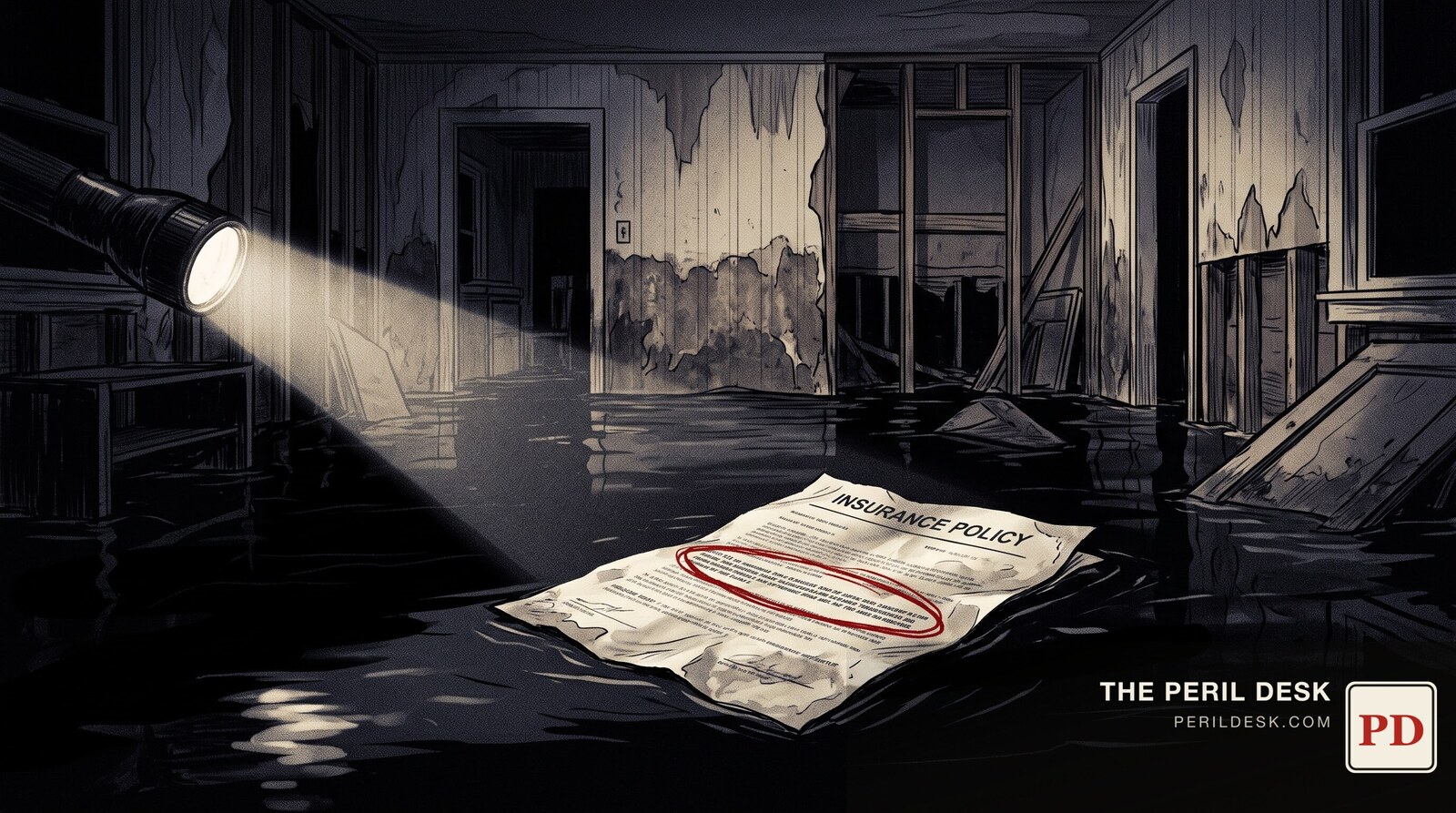
The distance between those two numbers was not a math dispute. It was a 21-word sentence buried in the exclusions, and that sentence beat nearly every homeowner who tested it in federal appeals court.
The sentence that survived the storm.
The Leonards' policy excluded water damage, then added this: "Such a loss is excluded even if another peril or event contributed concurrently or in any sequence to cause the loss." Insurance lawyers call it an anti-concurrent causation clause. In practice, when wind and surge destroyed a house together, in either order, the flood exclusion could swallow the whole loss unless the owner proved which specific damage wind alone had caused. On a slab, the proof had washed away with the house.
The Leonards sued, represented by Richard "Dickie" Scruggs, the Pascagoula lawyer who had helped force the tobacco industry into a $246 billion settlement. In August 2006, after a bench trial, U.S. District Judge L.T. Senter Jr. found that almost all the damage came from water and awarded the Leonards an additional $1,228.16. On August 30, 2007, the Fifth Circuit affirmed in an opinion by Chief Judge Edith H. Jones, holding the clause unambiguous and enforceable under Mississippi law. The same court upheld State Farm's version in Tuepker v. State Farm that year. Mississippi Attorney General Jim Hood had gone to state court in September 2005 to have the exclusions declared void. The clause held anyway.
What Kerri Rigsby found in the wind file.
While Leonard climbed through the courts, two sisters were reading claim files. Cori and Kerri Rigsby were veteran adjusters handling State Farm's Katrina claims through a contractor, E.A. Renfroe. One file belonged to Thomas and Pamela McIntosh of Biloxi, who held a State Farm wind policy and a $250,000 federal flood policy that State Farm administered for the National Flood Insurance Program. The arrangement mattered. When State Farm called damage "flood" on such a house, the federal government paid the bill instead of State Farm.
An engineer's first report on the McIntosh house concluded that wind destroyed it. Kerri Rigsby said she found that report carrying a sticky note that read, "Put in Wind file. DO NOT pay bill. DO NOT discuss." According to trial evidence later recounted by the Fifth Circuit, State Farm obtained a second report attributing the loss to water, paid the full $250,000 in federal flood money, denied further wind coverage, and never showed the McIntoshes the first report. In April 2006 the sisters filed a False Claims Act suit under seal, alleging State Farm was billing wind damage to the taxpayer.
The $50,000 that ended the crusade.
By then Scruggs had assembled the Scruggs Katrina Group and signed up 639 policyholders, including United States Senator Trent Lott, his brother-in-law, whose own Pascagoula home was slabbed. In January 2007, State Farm agreed to pay about $80 million to those plaintiffs and, in a companion deal with Hood, to reopen roughly 35,000 Mississippi claims while Hood closed his criminal investigation. Judge Senter refused to bless the class portion on January 26, 2007, writing that he lacked the information to know how many policyholders would benefit or how much each would receive. The reopened claims proceeded under state supervision instead.
Then the plaintiffs' side collapsed on itself. In November 2007, Scruggs was indicted for conspiring to bribe Mississippi Circuit Judge Henry Lackey with $50,000 for a favorable ruling in a $26.5 million dispute over Katrina legal fees. He pleaded guilty in March 2008. That June, U.S. District Judge Neal Biggers Jr. called the conduct "reprehensible," sentenced him to five years, and fined him $250,000. The most famous plaintiffs' lawyer in America lost his license over a fee fight about hurricane money.
One house, two reports, one jury.
The Rigsby case survived him. In April 2013, at a bellwether trial in Gulfport before U.S. District Judge Halil Suleyman Ozerden, a federal jury found that wind alone destroyed the McIntosh house and that State Farm had submitted a false claim to the National Flood Insurance Program for the $250,000 flood payment. The court trebled the damages to $750,000 and added an $8,250 civil penalty, a judgment of $758,250. The sisters received the maximum relator share, 30 percent, or $227,475. The Fifth Circuit affirmed in 2015.
State Farm carried one last argument to the Supreme Court: the complaint's court-ordered seal had been violated when the sisters' then-lawyers leaked it to journalists, so the case should be dismissed. On December 6, 2016, the Court ruled unanimously against State Farm, with Justice Anthony Kennedy writing that a seal violation does not require dismissal. The verdict stood, the only federal jury finding of a false Katrina claim against a major carrier.
Private insurers paid about $41.1 billion in insured Katrina losses. The National Flood Insurance Program paid $16.3 billion more, the taxpayer side of the wind and water line. In August 2022, State Farm's fire and casualty subsidiary agreed to pay the federal government $100 million to resolve the remaining Rigsby claims, sixteen years after the sisters filed under seal. The anti-concurrent causation clause was never struck down. It is still printed in homeowners policies sold along the Gulf Coast.